Should You Buy a Car with an Accident on the AutoCheck?
Should You Buy a Car with an Accident on the AutoCheck?
Seeing "accident reported" on a vehicle history report doesn't automatically mean walk away. Here's how to read it the right way — and when it's actually okay to buy.
You found the perfect truck or SUV, the price is right, the mileage looks good — then you check the vehicle history and see "accident reported." Your first instinct is to run. But should you?
Not necessarily. Accident reports vary wildly in severity, and understanding what you're actually looking at can save you from walking away from a perfectly good vehicle — or help you spot a deal-breaker before it's too late.
Not All Accidents Are the Same
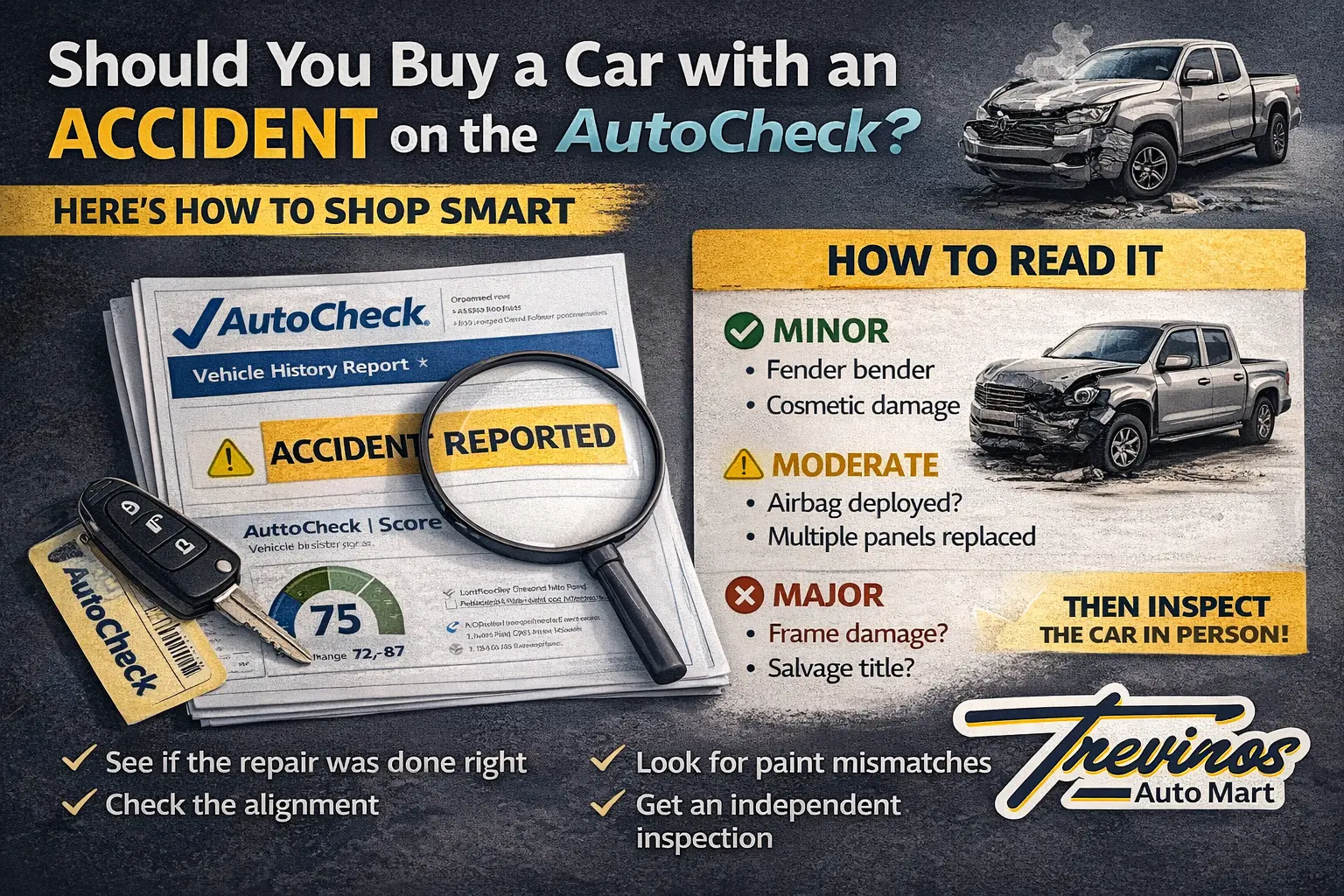
The word "accident" covers a huge range — from a minor fender bender in a parking lot to a serious collision that required major structural repair. An AutoCheck report will show that an accident was reported, but the level of detail depends on what was documented in the insurance claim or police report.
Here's how to think about the spectrum:
Minor incidents (generally not a concern):
- Low-speed parking lot bumps
- Minor fender benders with cosmetic damage only
- Small dents or scratches that required an insurance claim
- Replaced bumper covers, minor panel work
Moderate incidents (look closer):
- Side-impact or rear-end collisions with airbag deployment
- Damage requiring multiple panel replacements
- Suspension or alignment work after an accident
Major incidents (be very cautious):
- Structural or frame damage
- Flood damage or salvage/rebuilt title
- Multiple major accidents on the same vehicle
- Damage to critical safety systems (airbags, crumple zones)
What to Look for If a Vehicle Has an Accident Report
If a vehicle you're interested in has an accident on its AutoCheck, here's how to evaluate it like a pro:
- Read the report details carefully. AutoCheck reports often include information about the severity and type of damage. Look for keywords like "minor," "moderate," or "structural." Also note whether airbags deployed — that usually indicates a more significant impact.
- Check the AutoCheck Score. AutoCheck assigns a numerical score to every vehicle based on its history. A vehicle with a minor accident that was properly repaired will still have a reasonable score. A vehicle with major damage or multiple incidents will score noticeably lower. The score helps you compare one vehicle's history against another.
- Look at the repair history. Was the vehicle repaired at a professional body shop? Does the report show insurance involvement (which usually means it was fixed properly through a claim)? Professional repairs with insurance documentation are far better than vehicles with no record of how or where the damage was fixed.
- Inspect the vehicle in person. Look for signs of repaint: color mismatches between panels, overspray on rubber seals or trim, uneven panel gaps, or new bolts on hood hinges and fender mounts. These aren't necessarily bad — they just tell you work was done, and you can ask about it.
- Check the title. A clean title means the insurance company did not total the vehicle — the damage was repaired and the car was returned to service normally. A salvage or rebuilt title means the vehicle was declared a total loss at some point. Rebuilt title vehicles can be fine mechanically, but they're worth significantly less at resale and can be harder to finance and insure.
- Get an independent inspection if unsure. If you're on the fence, a pre-purchase inspection by an independent mechanic is worth the investment. They can check alignment, frame measurements, suspension components, and other areas that might reveal underlying damage.
How an Accident Report Affects Value
Here's the reality: a vehicle with an accident on its history typically sells for less than an identical vehicle with a clean report. That's just how the market works. But for a smart buyer, that can actually be an advantage.
If a vehicle had a minor fender bender, was professionally repaired, and drives perfectly — but it's listed at a lower price because of that accident report — you're getting more vehicle for your money. The key is making sure the damage was truly minor and the repair was done right.
When to Walk Away
There are some situations where an accident report should be a deal-breaker:
- Frame or structural damage. A vehicle with a bent or repaired frame is never the same. It can lead to alignment problems, uneven tire wear, safety concerns, and significantly reduced resale value.
- Flood damage. Water and electronics don't mix. Flood-damaged vehicles can have hidden electrical problems that surface weeks or months after purchase.
- Salvage title without documentation. If the vehicle was totaled and rebuilt but there's no documentation of the rebuild quality, that's too much risk.
- Multiple major accidents. One minor accident is understandable. Multiple significant incidents suggest the vehicle has lived a hard life.
- Something doesn't feel right during the test drive. If the car pulls to one side, makes unusual noises, or just doesn't feel right — trust your gut.
How Trevino's Auto Mart Handles This
At Trevino's, we provide an AutoCheck vehicle history report on every vehicle we sell. We believe in full transparency — you should know exactly what you're buying before you make a decision. If a vehicle on our lot has an accident on its history, we're not hiding it. It's right there in the report for you to review.
Our team will walk you through what the report says, answer your questions, and help you evaluate whether the vehicle is a good buy. We've been doing this since 1992 — we know what to look for, and we're happy to share that knowledge with you.
Browse our full inventory with vehicle history available on every listing, or reach out with questions about any vehicle on our lot.
Trevino's Auto Mart
2409 S 23rd Street, McAllen, TX 78503
(956) 686-7522
Monday – Friday: 9:30 AM – 6:30 PM | Saturday: 9:30 AM – 4:00 PM
Trevino's Auto Mart proudly serves McAllen, Mission, Pharr, Edinburg, Weslaco, Harlingen, Brownsville, and all of the Rio Grande Valley.