Is It Worth Buying a Used Ford F-150? What to Look For
Table of Contents
Is It Worth Buying a Used Ford F-150? What to Look For
The Ford F-150 has been America's best-selling truck for over 40 years. But is a used one worth your money? Here's what McAllen buyers need to know before pulling the trigger.
There's a reason the F-150 outsells everything else on the road. Ford has spent decades refining this truck, and the result is a vehicle that does just about everything well — towing, hauling, commuting, family duties, off-roading, you name it. The used F-150 market is massive, which means you've got options. But it also means you need to know what you're looking for so you don't end up with the wrong truck.
Let's get into it.
What Makes the Ford F-150 Worth Buying Used
Engine Options for Every Need
The F-150 gives you more engine choices than any other truck in its class. On the used market, you'll commonly find:
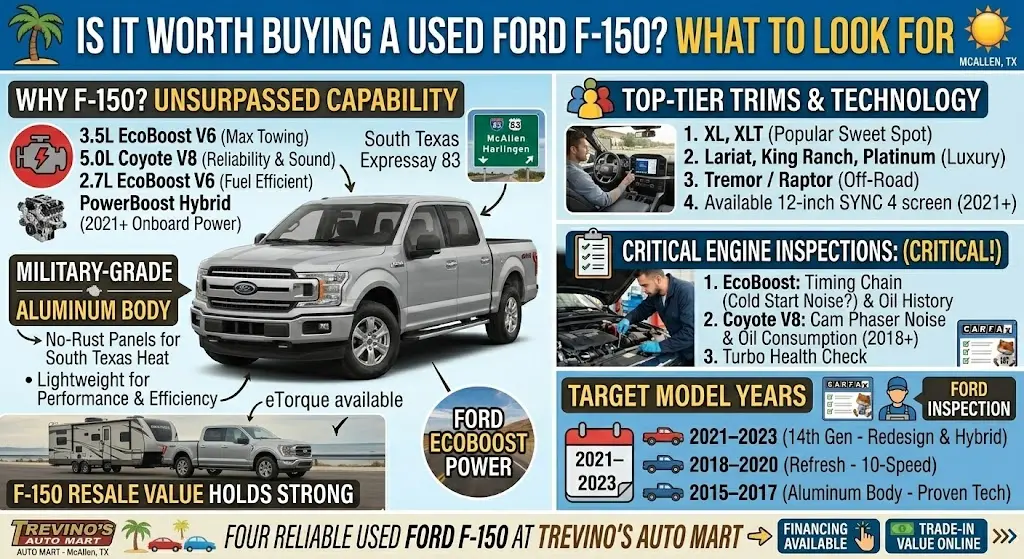
- 3.5L EcoBoost V6: The most popular engine choice, and for good reason. It makes serious power (375–400 hp depending on the year) while delivering better fuel economy than a traditional V8. It tows like a beast — maxing out around 13,000+ pounds in the right configuration. If you tow regularly, this is the engine to look for.
- 5.0L Coyote V8: The naturally aspirated V8 for buyers who want that classic truck sound and feel. It doesn't tow quite as much as the EcoBoost, but it's incredibly reliable, simpler to maintain, and has a massive aftermarket following. Valley buyers who plan to keep their truck for years love this engine.
- 2.7L EcoBoost V6: The fuel-efficient option. Don't let the smaller displacement fool you — it makes around 325 hp and has plenty of capability for daily driving and moderate towing. Great for commuters who still want full-size truck utility.
- PowerBoost Hybrid (3.5L V6 + Electric Motor): Found on 2021+ models. It's the most fuel-efficient F-150 ever made and comes with a built-in onboard generator (Pro Power Onboard). If you've ever needed to run power tools or electronics at a job site, this feature alone might sell you.
The Aluminum Body Is a Big Deal
Starting with the 2015 model year, Ford switched the F-150's body panels to military-grade aluminum. This was controversial at the time, but it's proven to be a smart move. The truck is lighter (better fuel economy, better performance), and aluminum doesn't rust the way steel does. For Valley buyers, that means less worry about body corrosion over time — even in our humid, salty air near the coast.
Resale Value Holds Strong
The F-150 consistently holds its resale value better than most trucks on the market. That's good news if you're buying used (the truck you're buying was built to last) and even better news if you ever plan to sell or trade it down the line.
F-150 Trims You'll See on the Used Market
- XL: The base work truck. Basic but capable. Rubber floors, cloth seats, the essentials. If you need a truck for work and don't need the extras, the XL gets the job done at the best price.
- XLT: The most popular trim by a wide margin. It adds a nicer interior, more tech (SYNC infotainment, better speakers), chrome accents, and power options. The XLT hits the sweet spot between price and features for most buyers.
- Lariat: Where things get premium. Leather seats, a larger touchscreen, more driver-assist features, and a noticeably more refined cabin. On the used market, you can find Lariats at a significant discount from their original sticker.
- King Ranch / Platinum / Limited: These are the luxury trims — full leather, premium audio, every tech feature Ford offers. They command higher prices used, but if you want a truck that doubles as a luxury vehicle, these deliver.
- Tremor / Raptor: Off-road focused trims with beefier suspension, all-terrain tires, and specialized tuning. Popular in the Valley for buyers who head out to ranches, hunting leases, or just want a truck that can handle anything.
What to Watch for on a Used F-150
EcoBoost-Specific Checks
The EcoBoost engines are excellent, but turbocharged engines need their maintenance done on time. On higher-mileage EcoBoost trucks, ask about:
- Timing chain condition. Early EcoBoost engines (2011–2017 range) had some timing chain stretch issues, particularly the 3.5L. Listen for a rattling sound on cold startup. This has been largely addressed on 2018+ models, but it's worth checking on older trucks.
- Turbo and intercooler health. Make sure the turbo spools properly under acceleration — there should be a smooth, strong pull of power with no unusual sounds or smoke. Check for any signs of condensation buildup in the intercooler, which can occasionally cause misfires on humid South Texas mornings.
- Oil change history. EcoBoost engines are more sensitive to oil condition than naturally aspirated engines. Regular synthetic oil changes are important. Check the CarFax service records.
5.0L V8-Specific Checks
The Coyote V8 is one of the most reliable engines Ford has ever made, but there are a couple of things to look for:
- Oil consumption on 2018+ models. Some owners of the Gen 3 Coyote (2018–2020) have reported slightly elevated oil consumption. Check the oil level during your inspection and ask if the owner needed to add oil between changes.
- Cam phaser noise. A ticking or knocking sound at startup that fades as the engine warms up can indicate cam phaser wear, particularly on higher-mileage 2018+ trucks. It's not always a major issue, but it's worth noting.
General Checks for Any F-150
- Transmission. The 10-speed automatic (found on 2017+ models) is generally reliable but should shift smoothly through all gears. Hard shifts, clunks, or hesitation during the test drive are red flags.
- Panoramic sunroof. If the truck has one, make sure it opens, closes, and seals properly. Sunroof leaks are a known complaint on some F-150 model years.
- Tailgate and bed. Check the tailgate dampener, inspect the bed for excessive wear, and test the power tailgate (if equipped). A spray-in bedliner is always a good sign.
- South Texas heat check. Run the A/C on max during the test drive. Check for any dashboard cracking, sun-faded seats, or weatherstripping deterioration. These are cosmetic issues, but they tell you how well the truck was cared for.
Best Model Years to Target
- 2021–2023 (14th Generation): The latest redesign brought a completely new interior, the available SYNC 4 system with a 12-inch screen, hybrid powertrain option, and improved towing capability. If budget allows, this is the generation to get.
- 2018–2020 (Refresh): A significant refresh of the 13th generation with updated engines, the new 10-speed automatic, an upgraded interior, and improved safety tech. Great value on the used market.
- 2015–2017 (Aluminum Body): The first generation with the aluminum body. A huge leap forward in weight savings and fuel efficiency. The 2015s had a few first-year quirks, but by 2016–2017, Ford had dialed it in.
Find Your F-150 at Trevino's Auto Mart
We consistently stock F-150s across multiple trims — XLTs, Lariats, and everything in between. Every truck on our lot comes with a full CarFax vehicle history report, and our no-pressure team will let you take your time, ask your questions, and make the decision that's right for you.
Need financing? Apply online in about five minutes. We work with multiple lenders for all credit situations.
Have a trade-in? Get your value online before you visit.
Trevino's Auto Mart
2409 S 23rd Street, McAllen, TX 78503
(956) 686-7522
Monday – Friday: 9:30 AM – 6:30 PM | Saturday: 9:30 AM – 4:00 PM
Trevino's Auto Mart proudly serves McAllen, Mission, Pharr, Edinburg, Weslaco, Harlingen, Brownsville, and all of the Rio Grande Valley.