Buy Locally in the RGV or Travel to a Bigger City?
Table of Contents
- Should You Buy a Car Locally in the RGV or Drive to San Antonio, Houston, or Dallas?
- The Hidden Costs of Buying Out of Town
- The Advantages of Buying Locally in the RGV
- But Don't Prices in Bigger Cities Have to Be Lower?
- When It Might Make Sense to Look Out of Town
- What to Do If You're Considering an Out-of-Town Purchase
- Shop Smart, Shop Local
Should You Buy a Car Locally in the RGV or Drive to San Antonio, Houston, or Dallas?
A lot of Valley buyers think they need to travel to a bigger city to get a better deal on a used car. Here's why that's usually not the case — and when it might actually make sense.
It's a conversation that happens all the time in the Rio Grande Valley: "I bet the prices are better in San Antonio" or "My cousin found a good deal in Houston." The idea makes intuitive sense — bigger city, more inventory, more competition, better deals. Right?
Not necessarily. When you add up the real costs and risks of buying out of town, the math often favors staying local. Let's break it down honestly.
The Hidden Costs of Buying Out of Town
That truck in San Antonio might look like it's a great deal on paper, but the sticker price doesn't tell the whole story. Here's what you need to factor in:
Real costs of a buying trip to San Antonio, Houston, or Dallas:
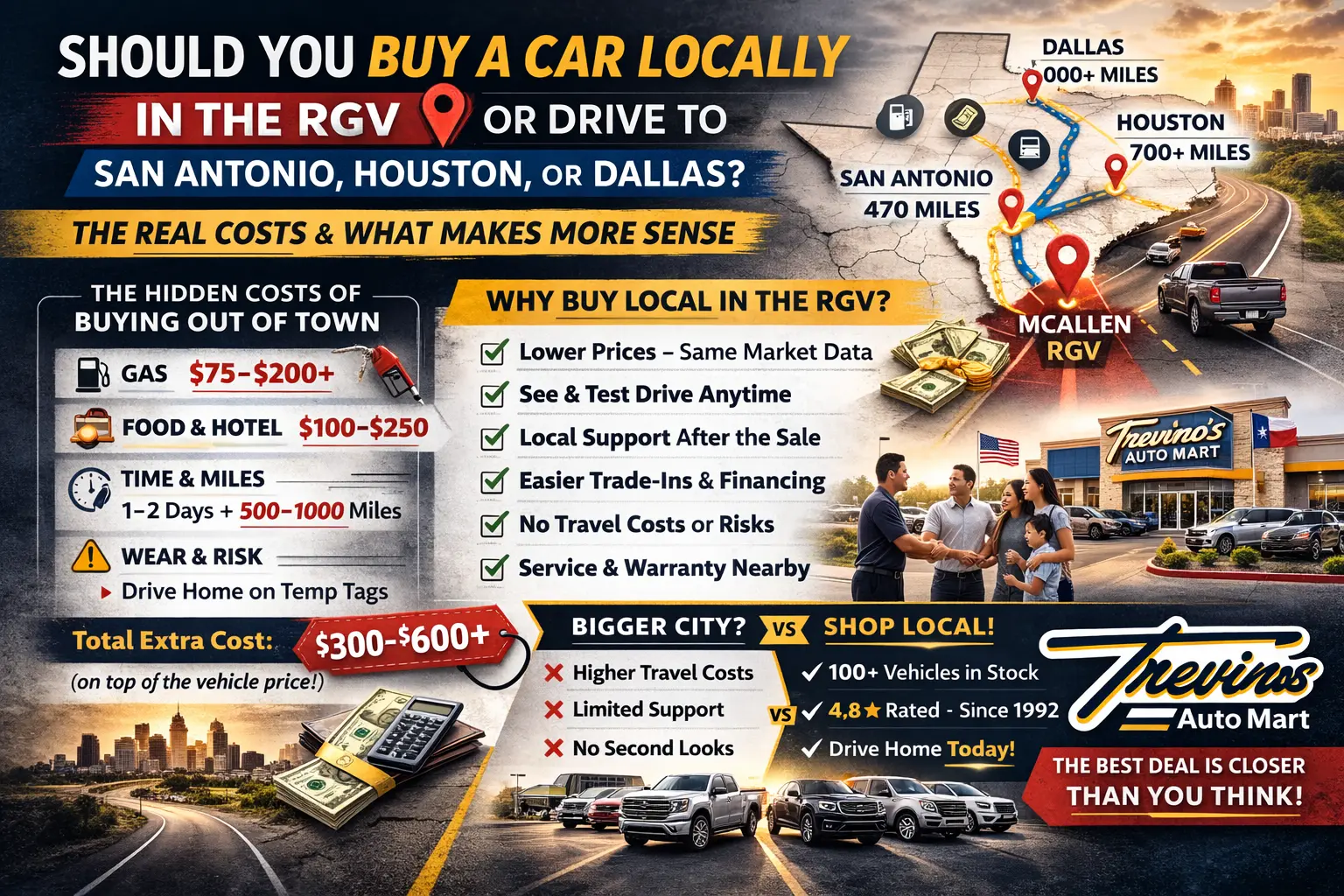
- Gas: A round trip from McAllen to San Antonio is about 470 miles. To Houston, 700+ miles. To Dallas, 1,000+ miles. At current gas prices, you're looking at $75–$200+ just in fuel — each way if you're driving a second vehicle home.
- Food and time: A full day minimum for San Antonio. An overnight trip for Houston or Dallas. That's meals, possibly a hotel, and a full day (or two) of your time.
- Wear on your current vehicle: Putting 500–1,000 miles on your existing car to go buy a different one isn't free. That's oil life, tire wear, and general mileage you can't get back.
- Bringing a second driver: If you're buying a car and need to drive it home, someone else needs to drive your original vehicle back. That means two people's time, two vehicles' worth of gas, and coordination.
- Temporary tags and transit risk: Driving an unfamiliar vehicle 4–6 hours home on temporary plates means you're putting highway miles on a vehicle you just bought, with no established relationship with a local dealership if something needs attention.
When you add it all up, that "deal" in a bigger city can easily cost you $300–$600+ in hidden expenses on top of the vehicle price. Suddenly the price difference isn't much of a difference at all.
The Advantages of Buying Locally in the RGV
Beyond avoiding travel costs, buying local comes with real benefits that out-of-town purchases can't match:
- You can see the vehicle in person — multiple times if needed. Want to come back for a second look? Bring your spouse or a mechanic? Easy. Try doing that with a vehicle in Houston.
- You build a relationship with a local dealer. If something comes up after the sale — a question about your vehicle, a warranty issue, or you're ready to trade up — your dealer is right down the road. Good luck getting that kind of support from a dealership 300 miles away.
- Local dealers know the local market. A dealership in the Valley understands what RGV buyers need and what they're dealing with — from South Texas heat considerations to the types of vehicles that are popular and hold value here. That local knowledge translates into better inventory selection and better advice.
- Test driving is stress-free. You can test drive during your lunch break, after work, or on a Saturday morning. No need to plan a whole trip around it.
- Financing is smoother. When you finance through a local dealership, everything happens in one place. No coordinating paperwork between cities, no waiting for out-of-state title transfers, no logistical headaches.
- Trade-ins are simpler. If you're trading in your current vehicle, you hand over the keys at the same place you pick up your new one. No figuring out how to get your trade-in to a dealership four hours away.
But Don't Prices in Bigger Cities Have to Be Lower?
This is the biggest misconception. Here's the reality:
Used car pricing is now a national market. Thanks to online listings, pricing tools, and wholesale auction data, a 2021 Chevy Silverado LT in McAllen is priced based on the same national market data as one in Houston. Dealerships everywhere — including right here in the Valley — use real-time market analytics to price their vehicles competitively. The days of dramatic price differences between cities are mostly over.
Bigger city doesn't mean better deal. In fact, dealerships in major metros often have higher overhead costs — more expensive real estate, bigger staffs, larger advertising budgets. Those costs get built into the business and can sometimes mean higher prices, not lower.
The Valley has competitive pricing. Independent dealerships like Trevino's Auto Mart have lower overhead than big-city mega-dealers. We source our vehicles at the same wholesale auctions and use the same market data to price competitively. Our customers get strong pricing without the travel hassle.
When It Might Make Sense to Look Out of Town
To be fair, there are a few scenarios where expanding your search beyond the Valley could be worth it:
- You're looking for a very specific, rare vehicle. If you need a particular year, trim, color, and option combination that nobody in the RGV currently has, widening your search makes sense. But even then, check with local dealers first — we can often source specific vehicles from our auction network.
- You find a deal that's significantly lower — not just slightly. If the price difference is a few hundred dollars, the travel costs eat that up. But if you find the same vehicle for $2,000–$3,000 less after accounting for all travel expenses, it might be worth the trip. Just make sure you verify the vehicle's condition and history before driving 300 miles.
- You're already going to be in that city. If you're visiting family in San Antonio anyway, there's no harm in stopping by a dealership. But going specifically to car shop? Do the math first.
What to Do If You're Considering an Out-of-Town Purchase
If you do decide to look at a vehicle in another city, protect yourself:
- Get the AutoCheck report before you go. Don't drive 4 hours only to find out the vehicle has a salvage title or major accident history.
- Confirm the vehicle is still available and the price is firm. Online listings can be outdated, and some dealers use low prices to attract you to the lot only to tell you that vehicle "just sold" and steer you to something else.
- Get an out-the-door price in writing — not just the sticker price. Ask for all taxes, fees, and dealer charges in a single number so there are no surprises.
- Have a plan for getting the vehicle home. Either bring a second driver or factor in the cost of transport.
- Know that warranty service will be local. If you buy a vehicle 300 miles away and it needs service under warranty, you'll likely be dealing with a local shop anyway — not the selling dealer.
Shop Smart, Shop Local
At Trevino's Auto Mart, we keep over 100 vehicles on our lot at any given time — cars, trucks, and SUVs from the brands Valley families want most. Every vehicle comes with an AutoCheck vehicle history report, competitive market-based pricing, and financing options for all credit situations.
We've been right here on South 23rd Street in McAllen since 1992. Over 10,000 vehicles sold. 4.8-star rating across 400+ reviews. No pressure, no games, and no 300-mile drive home on temporary plates.
Come see us. We think you'll find that the best deal is closer than you think.
Trevino's Auto Mart
2409 S 23rd Street, McAllen, TX 78503
(956) 686-7522
Monday – Friday: 9:30 AM – 6:30 PM | Saturday: 9:30 AM – 4:00 PM
Trevino's Auto Mart proudly serves McAllen, Mission, Pharr, Edinburg, Weslaco, Harlingen, Brownsville, and all of the Rio Grande Valley.