What Is a Good AutoCheck Score When Buying a Used Car?
Table of Contents
- What Is a Good AutoCheck Score When Buying a Used Car?
- What Is an AutoCheck Score?
- What Is Considered a Good AutoCheck Score?
- What Can Affect an AutoCheck Score?
- Vehicle age and class
- Number of previous owners
- Reported accidents or damage
- Title history
- Vehicle use
- Mileage history
- Is a High AutoCheck Score a Guarantee?
- Should You Avoid a Vehicle With a Lower Score?
- Why Two Similar Vehicles May Have Different Scores
- Do You Still Need to Read the Full Report?
- Questions to Ask the Dealership
- Review Used Vehicles at Trevino’s Auto Mart
What Is a Good AutoCheck Score When Buying a Used Car?
When shopping for a used car, you may see an AutoCheck vehicle-history report that includes a number called the AutoCheck Score.
But what does that number mean? More importantly, what is considered a good AutoCheck Score?
The answer is not the same for every vehicle. Instead of looking for one universal number, buyers should compare a vehicle’s score with the expected score range for other vehicles of a similar age and class.
Here is how the AutoCheck Score works and how you can use it when comparing used cars, trucks, and SUVs.
What Is an AutoCheck Score?
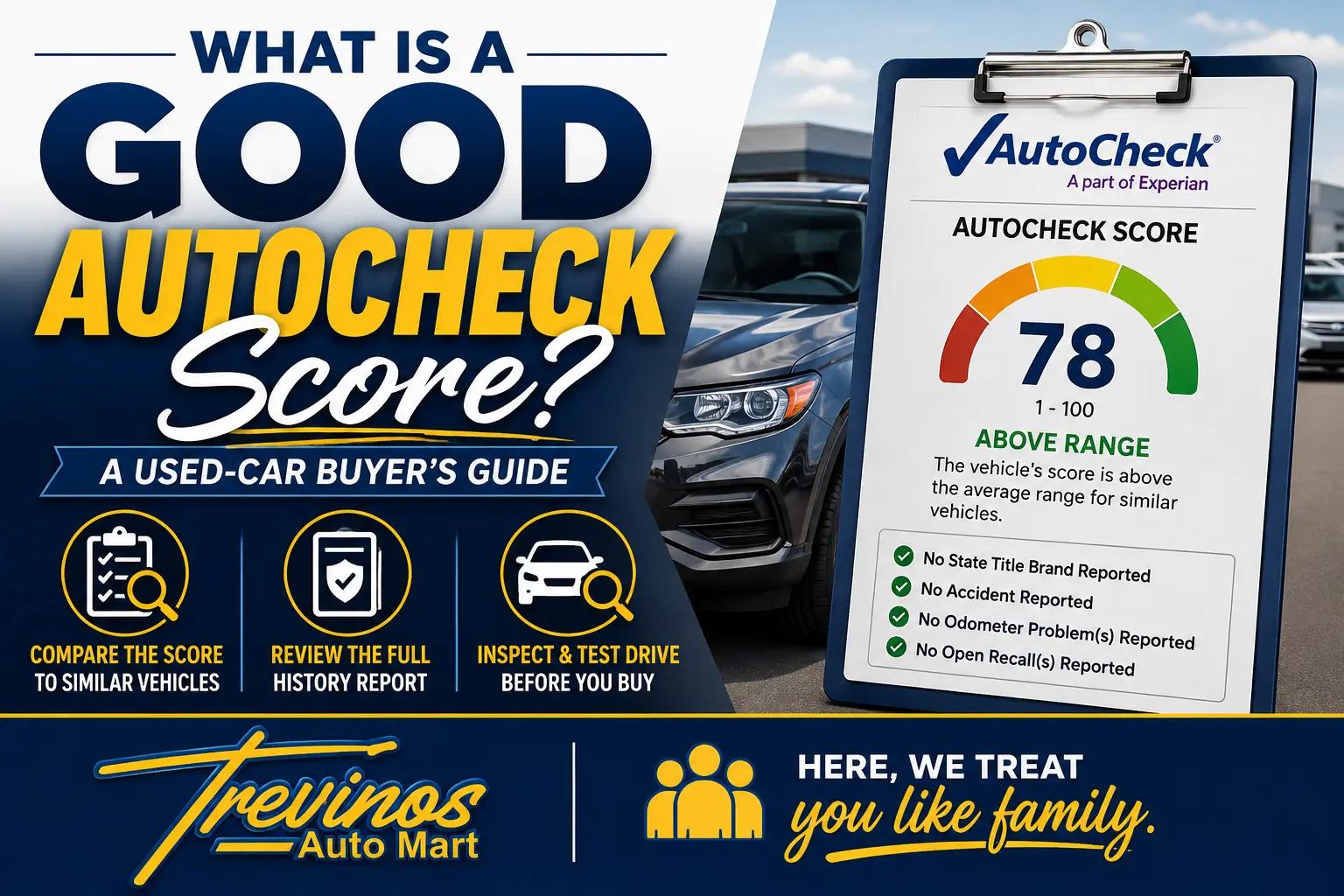
The AutoCheck Score is a numerical rating included in an AutoCheck vehicle-history report. It summarizes information from the vehicle’s reported history into a score ranging from 1 to 100.
The score is designed to make it easier to compare a vehicle with similar vehicles. AutoCheck considers information such as the vehicle’s age, class, number of owners, reported accidents, vehicle use, title history and other recorded events.
A higher score may appear more favorable, but the number should always be viewed together with the vehicle’s expected score range.
What Is Considered a Good AutoCheck Score?
There is no single AutoCheck Score that is considered good for every used vehicle.
An older pickup truck should not necessarily be compared with a newer compact car. That is why the report provides a score range for vehicles of a similar age and class.
In general:
- A score above the expected range may indicate that the vehicle compares favorably with similar vehicles.
- A score within the expected range means the vehicle falls within the typical range for similar vehicles.
- A score below the expected range means you should review the report carefully to understand which events may have affected it.
The comparison range is often more useful than the score alone. A score that looks low by itself may still be normal for a vehicle of that age and type.
What Can Affect an AutoCheck Score?
Several parts of a vehicle’s reported history may influence its score.
Vehicle age and class
A vehicle is compared with others of a similar age and class. Trucks, SUVs, luxury vehicles and compact cars may have different expected ranges.
Number of previous owners
The number and type of ownership changes recorded in the vehicle’s history may affect its score.
Reported accidents or damage
Reported accidents, structural damage and other damage events can influence the score. The details matter, so review the complete accident-and-damage section instead of relying only on the number.
Title history
Title brands such as salvage, rebuilt, flood or lemon-related records may be important warning signs. The report should be reviewed for any title issues or other major events.
Vehicle use
A report may contain information indicating whether the vehicle was used personally, commercially, as a rental or for another reported purpose.
Mileage history
Recorded odometer readings can help buyers identify mileage patterns or possible inconsistencies.
Not every event will affect every vehicle in the same way. AutoCheck uses a proprietary scoring model, so the full calculation is not shown on the report.
Is a High AutoCheck Score a Guarantee?
No. A high AutoCheck Score does not guarantee that a vehicle is free from mechanical problems or that it will never need repairs.
A vehicle-history report can only include information available from its reporting sources. A repair, accident or maintenance issue may not appear if it was never reported.
The AutoCheck Score should be used as a comparison tool—not as the only reason to purchase a vehicle.
Before buying, shoppers should also:
- Read the complete vehicle-history report
- Inspect the vehicle carefully
- Take a thorough test drive
- Review the mileage and title information
- Ask questions about previous damage
- Consider an inspection by an independent mechanic
The Federal Trade Commission recommends obtaining a vehicle-history report and considering an independent mechanical inspection before buying a used vehicle.
Should You Avoid a Vehicle With a Lower Score?
Not automatically.
A lower score means you should investigate why the vehicle scored below similar vehicles. The reason may be visible in the report, such as an accident, multiple ownership changes, commercial use or another recorded event.
Ask these questions:
- Is the score below, within or above the expected range?
- Does the report show a branded title?
- Is there reported structural or frame damage?
- Are the odometer readings consistent?
- How serious was any reported accident?
- Has the vehicle been inspected or repaired?
- Does its current condition match the information in the report?
The score can help you decide which questions to ask, but it cannot answer every question about the vehicle’s present condition.
Why Two Similar Vehicles May Have Different Scores
Two vehicles with the same year, make and model may have different AutoCheck Scores because their histories are different.
For example, one vehicle may have:
- Fewer previous owners
- No reported accidents
- Consistent mileage records
- Personal-use history
- No reported title problems
Another may have multiple owners, a reported accident, commercial use or an unusual mileage record.
Comparing the reports side by side can help you understand why one vehicle scored differently from another.
Do You Still Need to Read the Full Report?
Yes. The score is only a summary.
The complete AutoCheck report may include sections covering:
- Accident and damage history
- Title information
- Odometer records
- Ownership history
- Reported vehicle use
- Auction announcements
- Service or inspection records
- A detailed history timeline
A vehicle can have a score within the expected range while still containing an event you want to investigate. Always read the complete report before making a decision.
Questions to Ask the Dealership
When reviewing a vehicle-history report, consider asking:
- Is an AutoCheck or other vehicle-history report available?
- Can you explain the vehicle’s score and expected range?
- Does the report show any accidents or damage?
- Are there any title brands or mileage concerns?
- Has the vehicle received a mechanical inspection?
- Can I take the vehicle for a test drive?
- May I have the vehicle inspected by an independent mechanic?
A dealership should give you enough time to review the available vehicle information and ask reasonable questions before you make a decision.
Review Used Vehicles at Trevino’s Auto Mart
A good AutoCheck Score is not one specific number. The most useful approach is to compare the score with the expected range for similar vehicles and then review the complete history report.
At Trevino’s Auto Mart, you can browse available used cars, trucks and SUVs, review vehicle information and take a test drive to find an option that fits your needs.
Explore our current inventory online or visit us in McAllen, Texas.
Here, we treat you like family.