Used Ford Explorer vs. Chevrolet Traverse for McAllen Families
Table of Contents
- Used Ford Explorer vs. Chevrolet Traverse for McAllen Families
- Start With the Model Years You’re Comparing
- Compare Six, Seven, and Eight-Passenger Layouts Carefully
- Look at Cargo Space With Your Passengers’ Seats Upright
- Check the Engine and Drivetrain Before Comparing Fuel Economy
- Try Both SUVs in Your Everyday Driving Conditions
- Verify Convenience and Driver-Assistance Features by Vehicle
- Compare Vehicle Condition and Total Purchase Cost
- Which SUV Deserves a Closer Look?
- Compare Family SUVs at Trevino’s Auto Mart
Used Ford Explorer vs. Chevrolet Traverse for McAllen Families
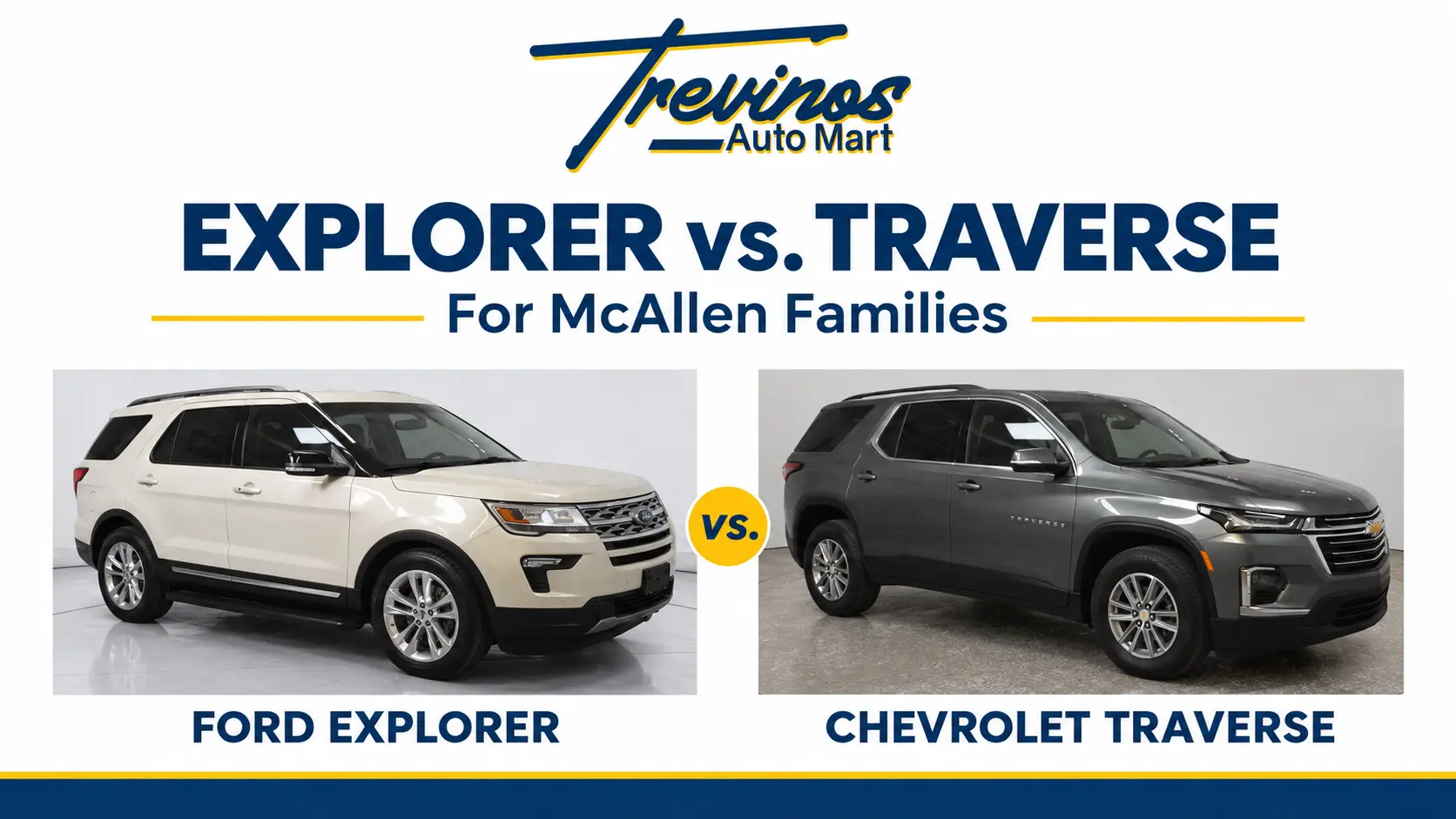
When comparing a used Ford Explorer vs. Chevrolet Traverse, start with the seats and cargo space your family actually needs. Using a 2021 Explorer and 2023 Traverse as examples, the Traverse offers more published cargo volume and configurations with more passenger positions. An Explorer may fit a household that prefers its seating arrangement, driving experience, or a particular engine and drivetrain combination.
Neither model name tells you everything about the vehicle. Model year, trim, equipment, condition, and price can change the comparison considerably.
For families driving around McAllen and the Rio Grande Valley, here’s how to compare these three-row SUVs before deciding which deserves a test drive.
Start With the Model Years You’re Comparing
This guide uses specifications from Ford’s 2021 Explorer brochure and Chevrolet’s 2023 Traverse materials for concrete examples. These are reference model years, not specifications that apply to every used Explorer or Traverse.
A 2018 Explorer, for instance, should be evaluated using its own model-year information. Likewise, equipment on a newer Traverse shouldn’t be assumed to appear on a 2023 model.
When browsing our current used SUV inventory, write down the year, trim, engine, drivetrain, and seating capacity of each vehicle that interests you. Comparing those details first helps prevent features from one listing getting mixed up with another.
Also consider the age difference. A newer model year and an older vehicle with different mileage or maintenance records may represent very different purchases.
Compare Six, Seven, and Eight-Passenger Layouts Carefully
Both SUVs offer three rows, but the number of usable passenger positions depends on the configuration.
For the 2021 Explorer XLT, Ford lists second-row captain’s chairs as standard equipment. That arrangement provides six seating positions, including two in the third row.
For the 2023 Traverse, Chevrolet lists eight-passenger seating on LS, seven-passenger seating on RS, Premier, and High Country, and seven- or available eight-passenger arrangements on LT.
Count your regular passengers before choosing a layout. If six people ride frequently, an additional passenger position may matter when a relative joins you. If your household rarely fills the third row, comfort and access may deserve more weight than the maximum head count.
Try the actual vehicle’s seats. Check legroom, seat-belt access, and how easily passengers can reach the third row. If you use child seats, follow both the vehicle and child-seat instructions when checking fit
Look at Cargo Space With Your Passengers’ Seats Upright
Cargo measurements are most useful when they match how you’ll use the SUV.
Ford publishes 18.2 cubic feet behind the third row for the 2021 Explorer and 87.8 cubic feet behind the front row with both rear rows folded. Chevrolet publishes 23.0 cubic feet behind the third row and 98.2 cubic feet with both rear rows folded for the 2023 Traverse.
Those published figures favor the Traverse for cargo volume in these examples. However, both manufacturers qualify cargo capacity by weight and distribution, and the shape of your belongings still matters.
With the dealership’s permission, try a stroller, suitcase, or other representative item in the cargo area. Keep the seats you need upright. Confirm that the liftgate closes normally and that your loading plan follows the owner’s manual.
For a closer look at seating versus luggage needs, read our two-row versus three-row SUV guide for McAllen drivers.
Check the Engine and Drivetrain Before Comparing Fuel Economy
A badge alone isn’t enough to compare fuel costs.
The 2021 Explorer XLT uses a 2.3-liter EcoBoost turbocharged four-cylinder engine and a ten-speed automatic transmission. Other Explorer trims can have different engines. The 2023 Traverse uses a 3.6-liter V6 and a nine-speed automatic transmission, with front-wheel drive or available all-wheel drive.
For a specific fuel-economy example, Ford’s 2021 brochure lists EPA-estimated ratings of 21 MPG city and 28 MPG highway for the 2.3-liter rear-wheel-drive Explorer. Chevrolet’s 2023 Traverse materials list 18 MPG city and 27 MPG highway for the front-wheel-drive V6 model.
Actual mileage varies. These figures don’t apply to every Explorer or Traverse configuration, and they don’t establish the full cost of ownership.
If you commute between McAllen and Edinburg or make frequent trips to Weslaco, compare the exact vehicles’ ratings alongside insurance quotes and expected maintenance expenses.
Try Both SUVs in Your Everyday Driving Conditions
Specifications help narrow the options. A test drive helps you understand how each vehicle works for you.
Use a similar route when possible, including local streets, appropriate highway driving, and a parking area. Adjust the driver’s seat and mirrors before setting off.
Pay attention to:
- Visibility when changing lanes, reversing, and parking.
- Seat support and whether passengers feel comfortable.
- Steering, braking, acceleration, and transmission operation.
- Road noise and any sounds you want explained.
- Air conditioning performance and the controls available to rear passengers.
Neither a larger cargo measurement nor a particular engine determines which vehicle you’ll prefer to drive. Compare your own observations, and ask the dealership about anything unfamiliar.
Our used-car test-drive checklist can help you make consistent notes on both SUVs.
Verify Convenience and Driver-Assistance Features by Vehicle
Features can differ even between vehicles with the same model year and trim name. Review the actual equipment and ask for a demonstration of anything important to you.
For example, Chevrolet’s 2023 Traverse information distinguishes between standard and available touchscreen sizes, liftgates, camera systems, and adaptive cruise control. An LT listing shouldn’t automatically be treated as having the equipment of a Premier or High Country.
Check practical features rather than building your decision around a long equipment list. Can your phone connect as expected? Can you operate the climate controls comfortably? Does the cargo access work for the person who normally loads groceries or a stroller?
Driver-assistance features have operating limits and don’t replace attentive driving. Read the owner’s manual for the equipment fitted to the specific SUV.
Compare Vehicle Condition and Total Purchase Cost
For a used Explorer or Traverse, the individual vehicle’s history and condition deserve as much attention as the model comparison.
Ask for the available vehicle-history report and maintenance records. Discuss tire and brake condition, any warning lights, and recommended upcoming work. Ask about arranging an independent pre-purchase inspection before making your decision.
Use the VIN to check for unrepaired safety recalls, and review the lookup tool’s limitations. A recall check provides different information from a maintenance record or mechanical inspection.
Request a written out-the-door price so you can review the complete purchase amount. Read the Buyers Guide and any written warranty information for that vehicle. Then consider ongoing expenses such as insurance, fuel, and routine service.
Avoid choosing solely because one SUV is newer or has a longer feature list. The combination of condition, equipment, costs, and fit should support your household’s needs.
Which SUV Deserves a Closer Look?
For the reference model years in this guide, put the Traverse high on your shortlist if the additional published cargo volume or a seven- or eight-passenger configuration addresses a regular need.
Consider the Explorer if its specific seating arrangement works for your passengers and you prefer how the vehicle feels during your test drive. If fuel use matters to your commute, compare the exact engine and drivetrain rather than assuming all Explorers share the same ratings.
Before visiting, choose your three priorities. That might be third-row access, space for a stroller, and operating costs. Bring the same priorities to both vehicles so your comparison stays useful.
Compare Family SUVs at Trevino’s Auto Mart
At Trevino’s Auto Mart in McAllen, you can take time to compare vehicles, check the seating arrangements, and ask about the details that matter to your family.
Start with a shortlist from our SUV inventory, then contact our team to confirm availability and plan a visit. Bring your passenger needs and a realistic idea of what you carry.
Whether you choose an Explorer, Traverse, or another SUV, focus on the vehicle that fits your everyday RGV driving and your household budget.