How Much Car Can I Afford?
How Much Car Can I Afford?
Before you start browsing inventory, figure out what you can realistically spend. Here's how to find the number that keeps you driving happy — and financially comfortable.
This is the question you should answer before you fall in love with a vehicle. It's easy to get caught up looking at a truck or SUV that checks every box, only to realize the monthly payment doesn't fit your life. The smart move is to know your number first, then shop within it.
Here's how to figure that out.
The 15–20% Rule
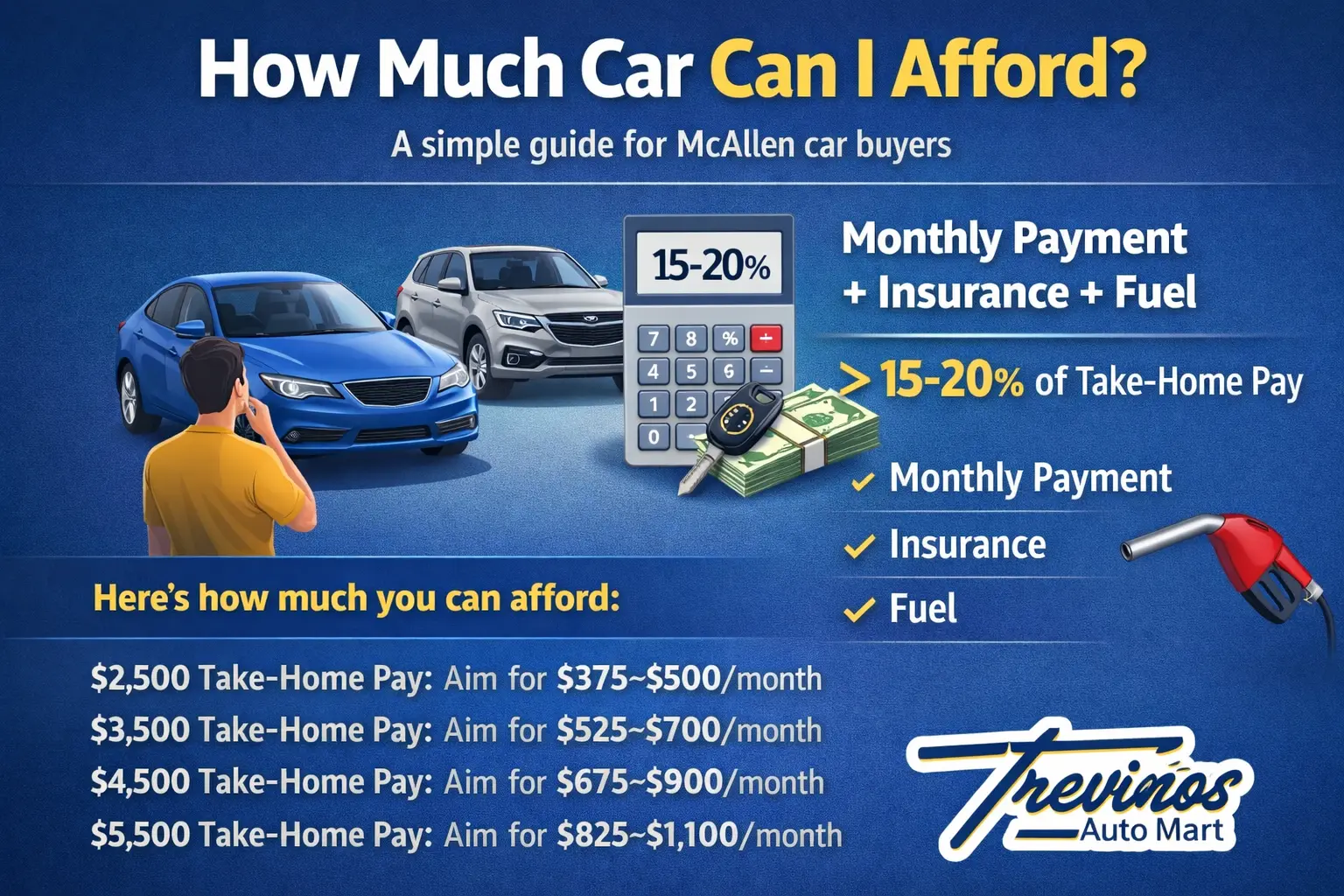
A widely used guideline in auto financing is the 15–20% rule: your total monthly vehicle costs — including your car payment and insurance — should be no more than 15–20% of your monthly take-home pay.
Take-home pay means the amount that actually hits your bank account after taxes, not your gross salary.
Here's what that looks like in real numbers:
- $2,500/month take-home: Aim for $375–$500/month total (payment + insurance)
- $3,000/month take-home: Aim for $450–$600/month total
- $3,500/month take-home: Aim for $525–$700/month total
- $4,000/month take-home: Aim for $600–$800/month total
- $5,000/month take-home: Aim for $750–$1,000/month total
These aren't hard rules — they're guardrails. Some people have low housing costs and can stretch a little. Others have higher expenses and need to stay on the lower end. The point is to avoid a payment that creates stress every month.
Don't Forget the Full Cost of Ownership
Your monthly payment is only part of the equation. When calculating what you can afford, factor in:
- Insurance. This varies based on your age, driving record, vehicle type, and coverage level. In the McAllen area, full coverage on a used truck or SUV can run anywhere from $100 to $250+ per month. If you're financing, your lender will require full coverage — not just liability.
- Fuel. A full-size truck is going to cost more at the pump than a compact sedan. Be realistic about your weekly driving and what you'll spend on gas.
- Registration and fees. Texas has annual registration fees, and you'll pay sales tax at purchase. These aren't monthly costs, but they're part of the first-year expense.
- Maintenance. Oil changes, tires, brakes — every vehicle needs upkeep. A well-maintained used car from a reputable dealer should have minimal surprise costs, but budget a small monthly cushion for maintenance.
Quick math: If you can afford $500/month total and you estimate insurance at $150/month, that leaves $350/month for your car payment. Knowing this number before you shop keeps you focused on the right vehicles.
How Your Down Payment Changes What You Can Afford
A bigger down payment lets you afford more vehicle for the same monthly payment — or keeps the same vehicle at a lower monthly cost. Either way, it works in your favor.
If you've got a vehicle to trade in, that counts toward your down payment too. Get your trade-in value online to see what you're working with before you shop.
For a deeper dive on down payments, check out our post: How Much Down Payment Do You Need to Buy a Car?
How Your Credit Affects What You Can Afford
Your credit situation doesn't change what vehicle you can buy — but it affects the interest rate you'll get, which directly impacts your monthly payment. A lower rate means more of your payment goes toward the vehicle and less goes toward interest.
- Excellent credit: You'll qualify for the lowest rates, which means lower payments and more purchasing power.
- Good credit: Rates will be competitive. You'll have solid options.
- Fair or rebuilding credit: Rates will be higher, which means your monthly payment will be a bigger portion of the vehicle cost. A larger down payment helps offset this.
- No credit / first-time buyer: Rates vary depending on the lender and your overall financial picture. Some lenders specialize in first-time buyers and offer reasonable terms.
At Trevino's Auto Mart, we work with multiple lenders across the credit spectrum. Our finance team shops your application to find the best terms available for your situation — which can save you real money over the life of the loan.
The Loan Term Matters Too
It's tempting to stretch your loan to 72 or 84 months to get a lower payment, but longer terms mean more total interest paid. Here's the trade-off:
- 36–48 months: Higher monthly payments but you pay the least total interest and own the vehicle free and clear faster.
- 60 months: A good middle ground for most buyers. Reasonable monthly payments without an excessive interest bill.
- 72–84 months: Lowest monthly payment, but you'll pay more interest overall and risk being upside down on the loan (owing more than the car is worth) for a longer period.
The right term depends on your budget and goals. Our finance team can show you how different loan lengths affect both your monthly payment and total cost.
A Simple Way to Start Shopping
Here's a practical approach:
- Step 1: Calculate 15–20% of your monthly take-home pay.
- Step 2: Subtract estimated insurance costs.
- Step 3: The remaining number is your target car payment.
- Step 4: Browse our inventory — every listing shows an estimated monthly payment, so you can filter for vehicles that fit your budget.
- Step 5: When you find something you like, apply online or come see us. We'll run real numbers based on your specific situation.
Let Us Help You Find the Right Fit
We've been helping Valley families find vehicles that fit their budgets — not stretch them — since 1992. Over 10,000 vehicles sold, a 4.8-star rating, and a no-pressure approach that lets you take your time and make the right decision.
Come by, call us, or start online. We'll help you figure out what works.
Trevino's Auto Mart
2409 S 23rd Street, McAllen, TX 78503
(956) 686-7522
Monday – Friday: 9:30 AM – 6:30 PM | Saturday: 9:30 AM – 4:00 PM
Trevino's Auto Mart proudly serves McAllen, Mission, Pharr, Edinburg, Weslaco, Harlingen, Brownsville, and all of the Rio Grande Valley.