AWD vs. 4WD: What’s the Difference for McAllen, TX Drivers?
Table of Contents
- AWD vs. 4WD: What’s the Difference for McAllen, TX Drivers?
- The Quick Answer: AWD vs. 4WD
- What Is All-Wheel Drive?
- AWD may be a good fit if:
- What Is Four-Wheel Drive?
- 2WD or 2H
- 4WD High or 4H
- 4WD Low or 4L
- 4WD may be a good fit if:
- Is 4x4 the Same as 4WD?
- Which Is Better for Driving in McAllen and the RGV?
- Daily commuting and city driving
- Rain and wet roads
- Ranch roads and job sites
- Beach and weekend travel
- Does AWD or 4WD Help With Towing?
- Does AWD or 4WD Use More Fuel?
- What Should You Check When Buying a Used AWD or 4WD Vehicle?
- AWD vs. 4WD: Which One Should You Choose?
- Shop Used AWD and 4WD Vehicles in McAllen, TX
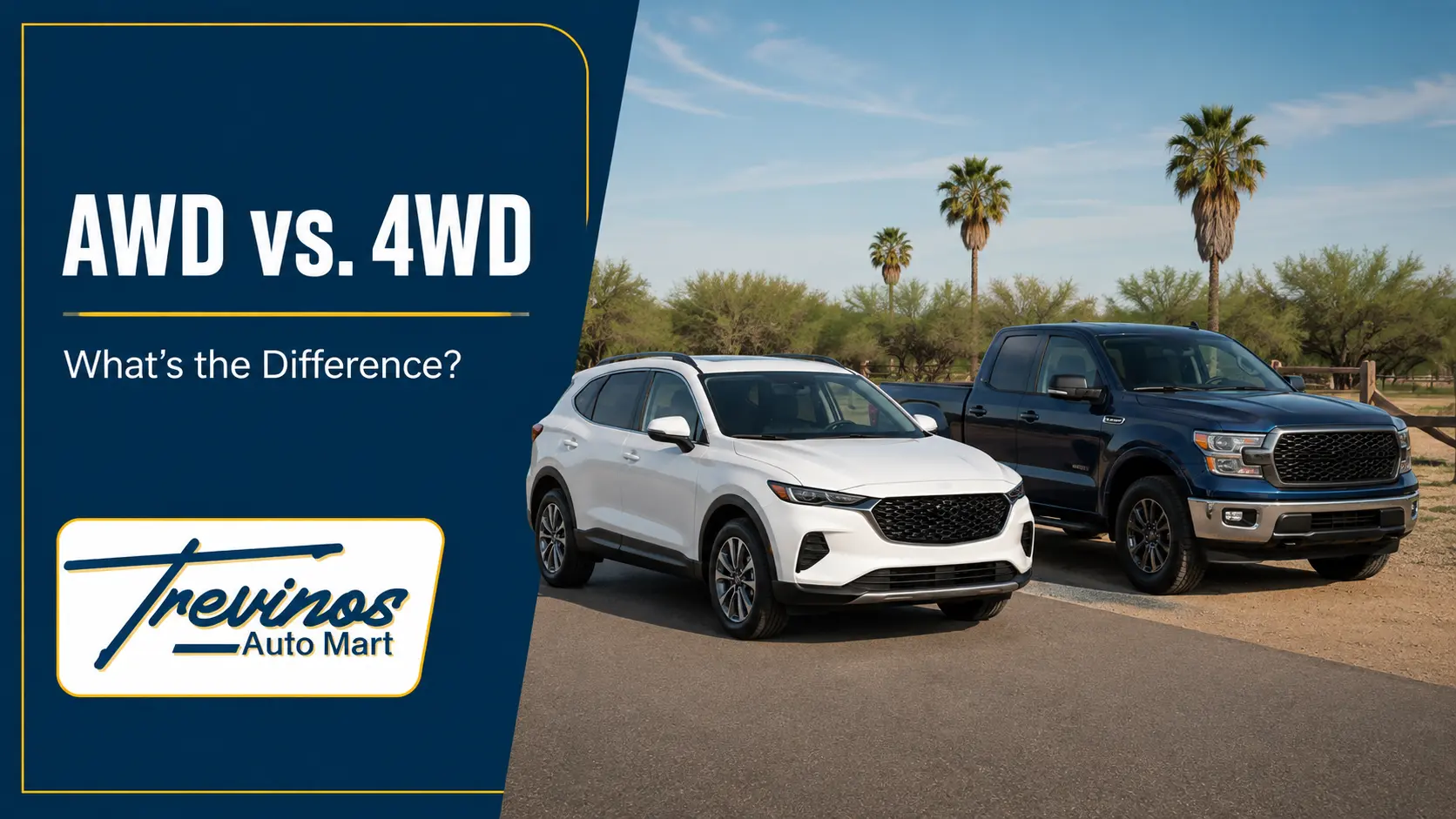
AWD vs. 4WD: What’s the Difference for McAllen, TX Drivers?
When shopping for a used SUV or truck, you may see terms such as AWD, 4WD, 4x4, FWD, and RWD in the vehicle description. AWD and 4WD may sound like two names for the same feature because both can send power to all four wheels. However, they usually work differently and are designed with different types of driving in mind.
For most drivers in McAllen and the Rio Grande Valley, the right choice depends on where the vehicle will be driven, how it will be used, and whether extra off-road capability is actually needed. Someone commuting between McAllen and Pharr may have different priorities than someone who regularly travels on ranch roads, visits job sites, or pulls a trailer.
This guide explains the difference between AWD and 4WD in simple terms so you can decide which system may be the better fit before browsing the current used inventory at Trevino’s Auto Mart.
The Quick Answer: AWD vs. 4WD
All-wheel drive, or AWD, typically operates automatically. Depending on the system, the vehicle may power all four wheels continuously or send additional power to the other axle when sensors detect that extra traction is needed. The driver usually does not need to turn AWD on.
Four-wheel drive, also called 4WD or 4x4, is common in trucks and more rugged SUVs. Many 4WD systems allow the driver to select a mode such as two-wheel drive, 4WD High, or 4WD Low. They are often designed for more demanding conditions, including loose dirt, mud, sand, steep terrain, or slow off-road driving.
Modern systems vary by manufacturer, model, year, and trim. Some AWD vehicles include special terrain modes, while some 4WD vehicles can automatically manage power in certain settings. Always review the vehicle’s equipment and owner’s manual instead of relying only on the AWD or 4WD badge.
What Is All-Wheel Drive?
AWD is commonly found in crossovers, SUVs, and some cars. Its main purpose is to manage traction during normal driving without requiring much input from the driver.
Some AWD systems send power to all four wheels most of the time. Others mainly operate as front-wheel drive or rear-wheel drive and automatically send power to the other axle when the system detects wheel slip or changing road conditions.
Because the process is automatic, AWD can be convenient for everyday use. It may help a vehicle maintain traction when accelerating on a wet or loose surface. It can also give some drivers additional confidence during changing weather conditions or on lightly unpaved roads.
However, AWD does not make a vehicle immune to sliding, hydroplaning, or losing control. It does not replace good tires, safe speeds, proper following distance, or careful driving. The condition of the tires and brakes remains important no matter which drivetrain a vehicle has.
AWD may be a good fit if:
- You mainly drive on paved streets and highways.
- You want the system to respond automatically when additional traction is needed.
- You are shopping for a crossover or family SUV.
- You occasionally travel on gravel, dirt, or lightly unpaved roads.
- You do not need the heavier off-road features available in some 4WD vehicles.
What Is Four-Wheel Drive?
Four-wheel drive is most often found in pickup trucks and SUVs designed for tougher use. Many 4WD vehicles normally operate in two-wheel drive and allow the driver to engage four-wheel drive when conditions call for it.
The available settings depend on the vehicle. A truck may have buttons, a dial, a lever, or an automatic mode for selecting the drivetrain setting. Common modes can include:
2WD or 2H
In this setting, the vehicle sends power to two wheels during regular driving. On many trucks, those are the rear wheels. This mode is generally used on dry, paved roads.
4WD High or 4H
This setting sends power to all four wheels and is intended for certain low-traction conditions. Depending on the vehicle, it may be used on loose dirt, mud, sand, or other slippery surfaces. The recommended speed and conditions vary, so the driver should follow the owner’s manual.
4WD Low or 4L
This setting uses lower gearing to provide greater control and torque at low speeds. It is intended for demanding situations such as deep sand, steep grades, rough terrain, or getting through a difficult off-road area. It is not a normal setting for everyday highway driving.
Not every four-wheel-drive vehicle includes all of these modes. Some newer systems have an automatic 4WD setting or selectable terrain modes. Before buying, ask how the specific system works and when each mode should be used.
4WD may be a good fit if:
- You regularly drive on ranch roads, muddy areas, loose sand, or rough terrain.
- Your work takes you to construction sites or other unpaved locations.
- You want a truck or rugged SUV with added off-road capability.
- You need low-range gearing for specific driving situations.
- You understand when and how to engage the vehicle’s different 4WD settings.
Is 4x4 the Same as 4WD?
In most vehicle listings, 4x4 and 4WD are used to describe the same general type of system: a vehicle that can send power to all four wheels. A truck advertised as a 4x4 is normally equipped with four-wheel drive.
However, the exact hardware and available modes can differ from one model to another. One 4x4 truck may include 4WD Low and several terrain settings, while another may have a simpler system. Confirm the equipment on the specific vehicle you are considering.
Which Is Better for Driving in McAllen and the RGV?
Neither AWD nor 4WD is automatically better for everyone. The better choice is the one that matches how you actually drive.
Daily commuting and city driving
If most of your driving is on paved roads around McAllen, Mission, Pharr, Edinburg, or Weslaco, you may not need 4WD. A front-wheel-drive car or SUV can be enough for many local commuters. AWD may still appeal to shoppers who want automatic traction management, but it is not a requirement for ordinary city driving.
Rain and wet roads
AWD can help manage power when accelerating on a wet surface, but it cannot prevent every loss of traction. Safe speed, properly inflated tires, good tread, working brakes, and extra following distance are especially important during heavy South Texas rain.
A 4WD system may also provide additional traction in an appropriate mode, but some traditional part-time 4WD settings are not meant for normal dry pavement. Always use the setting recommended by the manufacturer.
Ranch roads and job sites
Drivers who regularly encounter dirt, mud, deep ruts, or rough work areas may benefit more from a properly equipped 4WD truck or SUV. Ground clearance, tires, suspension, and recovery equipment can matter just as much as the drivetrain, so look at the entire vehicle rather than the 4x4 badge alone.
Beach and weekend travel
If your plans include driving on loose sand where vehicle access is allowed, a capable 4WD vehicle may be helpful. Sand driving still requires preparation, the right tires, careful operation, and knowledge of the vehicle’s recommended settings. Follow all posted rules and avoid assuming that 4WD guarantees a vehicle cannot get stuck.
For ordinary highway trips to South Padre Island, San Antonio, or other destinations, comfort, fuel economy, cargo space, and vehicle condition may matter more than having 4WD.
Does AWD or 4WD Help With Towing?
A 4WD truck can be helpful when launching a boat, moving a trailer on a loose surface, or reaching a work area with limited traction. However, four-wheel drive by itself does not determine how much a vehicle can tow.
Towing capacity depends on the specific model, engine, transmission, axle ratio, cab and bed configuration, hitch equipment, and other factory specifications. Two trucks that look almost identical may have different tow ratings.
If towing is important, tell the dealership what you plan to pull and the approximate loaded trailer weight. Confirm the vehicle’s tow rating and equipment before making a decision.
Does AWD or 4WD Use More Fuel?
Adding components that send power to four wheels can add weight and mechanical complexity. As a result, an AWD or 4WD version of a vehicle may have different fuel economy than a comparable two-wheel-drive version.
Actual fuel use depends on the vehicle, engine, system design, tires, maintenance, driving habits, traffic, and road conditions. Instead of assuming that every AWD or 4WD vehicle uses the same amount of fuel, compare the information for the exact year, model, engine, and drivetrain you are considering.
If you do not regularly need additional traction or off-road capability, a two-wheel-drive vehicle may better fit your priorities. If you will use the added capability often, the tradeoff may make sense.
What Should You Check When Buying a Used AWD or 4WD Vehicle?
The drivetrain should be part of your inspection and test drive. Before buying, consider these steps:
- Confirm the drivetrain. Do not assume a vehicle has AWD or 4WD based on its appearance. Verify the VIN, listing, window sticker, and equipment.
- Ask how the system operates. Find out whether it is full-time, automatic, or selectable and whether it includes 4WD High, 4WD Low, or terrain modes.
- Check the dashboard. Look for drivetrain warning lights or messages when the vehicle starts.
- Test the controls. If conditions allow, ask the dealership to demonstrate the different settings according to the manufacturer’s instructions.
- Inspect the tires. All four tires should be the proper size and should have appropriate condition and tread. Some AWD systems can be sensitive to major differences in tire size or wear.
- Review the vehicle history and maintenance. Service records can help you understand how the vehicle was maintained and whether drivetrain repairs were reported.
- Consider an independent inspection. A qualified mechanic can inspect the drivetrain, suspension, tires, and other components before purchase.
AWD vs. 4WD: Which One Should You Choose?
Choose AWD if you want automatic traction management for everyday paved-road driving, changing weather, and occasional light-duty travel on gravel or dirt. It is commonly available in crossovers and family SUVs and generally requires little action from the driver.
Choose 4WD if you regularly face demanding terrain, ranch roads, mud, deep sand, job sites, or other conditions where a more rugged system and low-range gearing may be useful. It is commonly found in trucks and off-road-oriented SUVs.
You may also decide that neither system is necessary. A front-wheel-drive or rear-wheel-drive vehicle may offer everything you need for commuting, errands, and regular highway travel in the Rio Grande Valley.
The smartest choice is based on your real driving habits, not simply which badge sounds more capable.
Shop Used AWD and 4WD Vehicles in McAllen, TX
Trevino’s Auto Mart offers a changing selection of used cars, trucks, and SUVs for drivers throughout McAllen and the Rio Grande Valley. Our team can help you confirm whether a vehicle is equipped with AWD, 4WD, or two-wheel drive and explain the features available on that specific model.
Start by browsing our used SUVs, used trucks, or complete used inventory. Because used inventory changes as vehicles are sold and new arrivals are added, confirm availability before visiting.
When you are ready, stop by Trevino’s Auto Mart at 2409 S. 23rd St. in McAllen, TX, or call (956) 686-7522. Here, we treat you like family.
Vehicle features, drivetrain operation, equipment, pricing, and availability may vary. Confirm all details on the specific vehicle and follow the manufacturer’s instructions. Financing is subject to lender approval; rates and terms vary. Taxes, title, license, and applicable fees are additional.